
The Landscape Company
Haslemere · Surrey
Choosing between porcelain and sandstone is one of the most common decisions when planning a new patio in Haslemere. Both can make an excellent finished terrace, but they behave differently and suit different styles of garden.
The right choice is not simply a question of which material is "better". Appearance, maintenance, installation requirements, drainage, access and the character of the property all matter — particularly in Haslemere, Hindhead, Shottermill, Grayswood and the surrounding Surrey Hills.
Haslemere sits within a varied landscape of the Surrey Hills and Wealden Greensand. Around Haslemere, Hindhead and Beacon Hill the underlying landscape includes sandstone and complex, steeply changing ground. That means there is no single "Haslemere soil" or standard patio construction that suits every property.
For a patio, however, the material choice is only one part of the equation. A well-built sub-base, suitable falls and drainage, correct bedding and good detailing around the house will normally matter far more to the long-term performance of the patio than whether the surface is porcelain or sandstone.
A manufactured paving product with very low water absorption and a clean, consistent appearance. It is particularly popular where homeowners want a contemporary terrace with relatively low routine maintenance.
A natural stone with variation in colour, texture and surface character. Sandstone works particularly well where the patio needs to sit comfortably with an older property, traditional garden or more natural planting scheme.
Porcelain is increasingly popular for patios around Haslemere because it gives a crisp, contemporary finish and is relatively resistant to staining and water absorption. It can work particularly well where the garden design uses clean lines, rendered walls, modern planting or a contemporary extension.
Porcelain is not simply a case of putting tiles onto a patio base. The paving is relatively unforgiving of poor preparation and needs a suitable full-bed installation with appropriate materials and attention to falls, drainage and jointing.
Cutting and handling also require the correct equipment and care. On a difficult Haslemere site with restricted access, steep levels or long material-carrying distances, these installation requirements can affect the overall cost.
Natural sandstone remains a popular choice for Haslemere gardens because of its softer, more varied appearance. The natural variation between individual slabs can help a patio blend into established gardens and traditional properties.
Sandstone is a natural material, so its appearance and performance depend on the particular stone selected. Some products are more porous than others, and the surface can change over time through weathering, organic growth and general use.
In shaded or damp areas around Haslemere, good drainage and sensible maintenance become particularly important. The paving itself cannot compensate for water being allowed to remain against or beneath the patio.
Haslemere and the surrounding Surrey Hills contain a mixture of geological and ground conditions. The Hindhead and Haslemere area is associated with the Greensand landscape, while individual gardens can contain made ground, clay, sand, gravel, roots or previous construction materials.
Gardens can also change dramatically over short distances. A level garden close to the road may present very different construction conditions from a steep rear garden with retaining walls and mature trees.
That is why we do not regard porcelain or sandstone as a substitute for proper ground preparation. The patio needs to be designed around the actual site.
One of the biggest practical differences between the two materials is how they behave during everyday use.
Slip resistance should be considered alongside the location and use of the patio. A smooth-looking surface is not automatically unsafe, and a heavily textured surface is not automatically suitable for every situation.
For either porcelain or sandstone, the specific product, surface finish, drainage and surrounding conditions should be considered. Areas that remain persistently wet, shaded or covered by leaves will require more attention than an open, sunny terrace with good drainage.
The installation process differs between the two materials.
Porcelain paving requires careful preparation, accurate cutting and a suitable full-bed installation. The paving must be properly supported beneath the slab, with appropriate falls and drainage incorporated into the design.
Sandstone also requires a properly prepared sub-base and suitable bedding. Individual slabs can vary in thickness and surface character, so the laying process often involves more adjustment from slab to slab.
In both cases, the finished patio is only as good as the construction beneath it. Poor excavation, inadequate sub-base, unsuitable bedding or badly designed drainage can cause movement or other problems regardless of the paving material.
There is no meaningful single price for either material because the cost of a patio depends on far more than the paving itself.
Access, excavation, ground conditions, waste removal, sub-base requirements, drainage, steps, retaining walls, cutting, laying pattern and the amount of preparation required can all have a significant effect on the final price.
Porcelain paving is often more expensive as a complete installation because of the product cost and the additional care required during installation. However, premium sandstone can also be expensive, and a straightforward porcelain patio can sometimes cost less than a complicated sandstone installation.
For that reason, comparing the cost per square metre of the paving alone can give a misleading impression of the actual project cost.
There is no universal winner. The better material depends on the property, garden, architecture, budget and the appearance you want to achieve.
On many Haslemere projects, the decision becomes clearer once the existing garden levels, access and character of the property have been considered.
If you're considering porcelain or sandstone paving, we can look at the garden as a whole and advise on the appropriate construction, drainage, levels and material choice.
If you want to understand the materials themselves in more detail, our deeper knowledge guides look beyond the simple porcelain-versus-sandstone question.
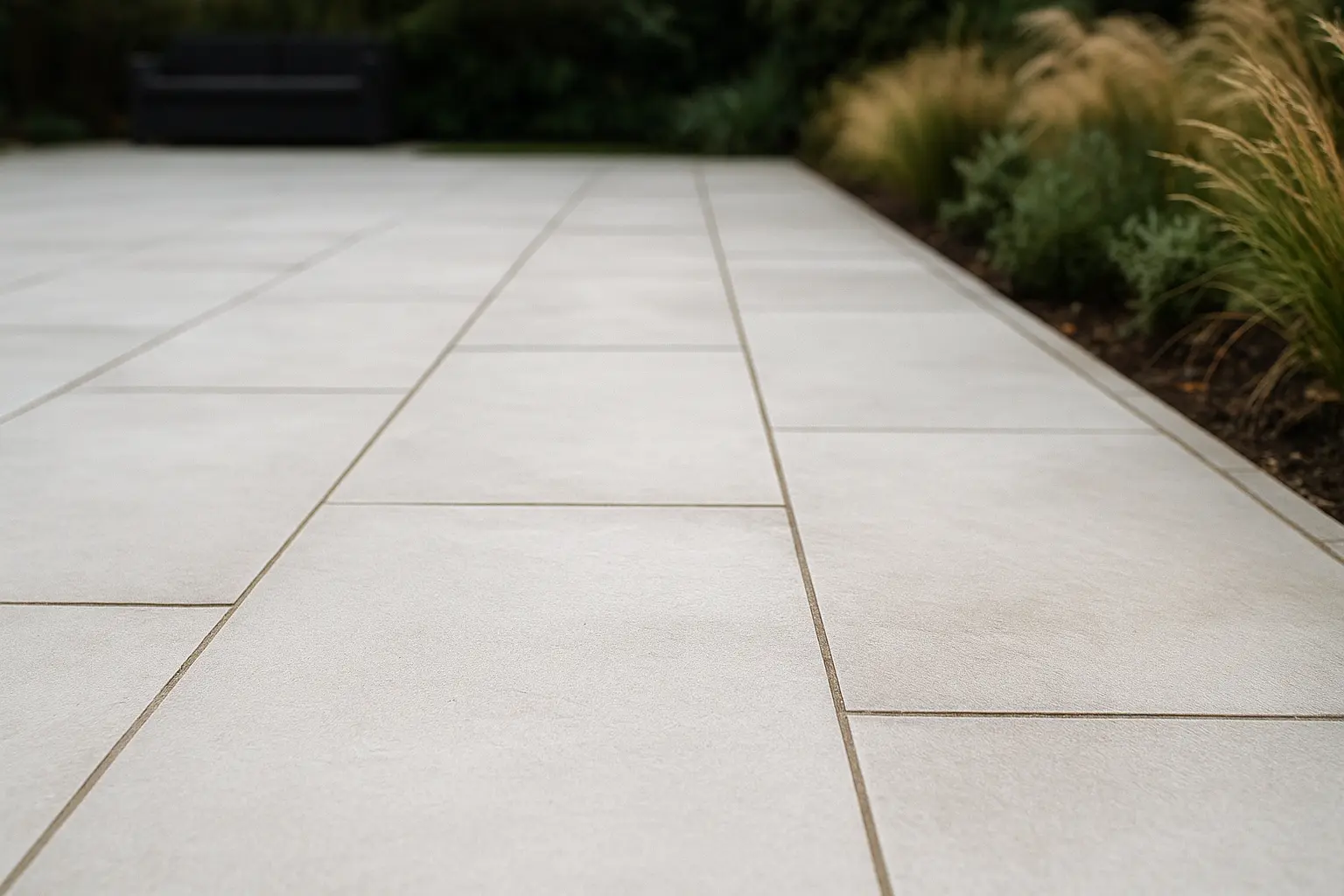
Explore how porcelain is manufactured, why it has low water absorption, and what that means for outdoor paving.
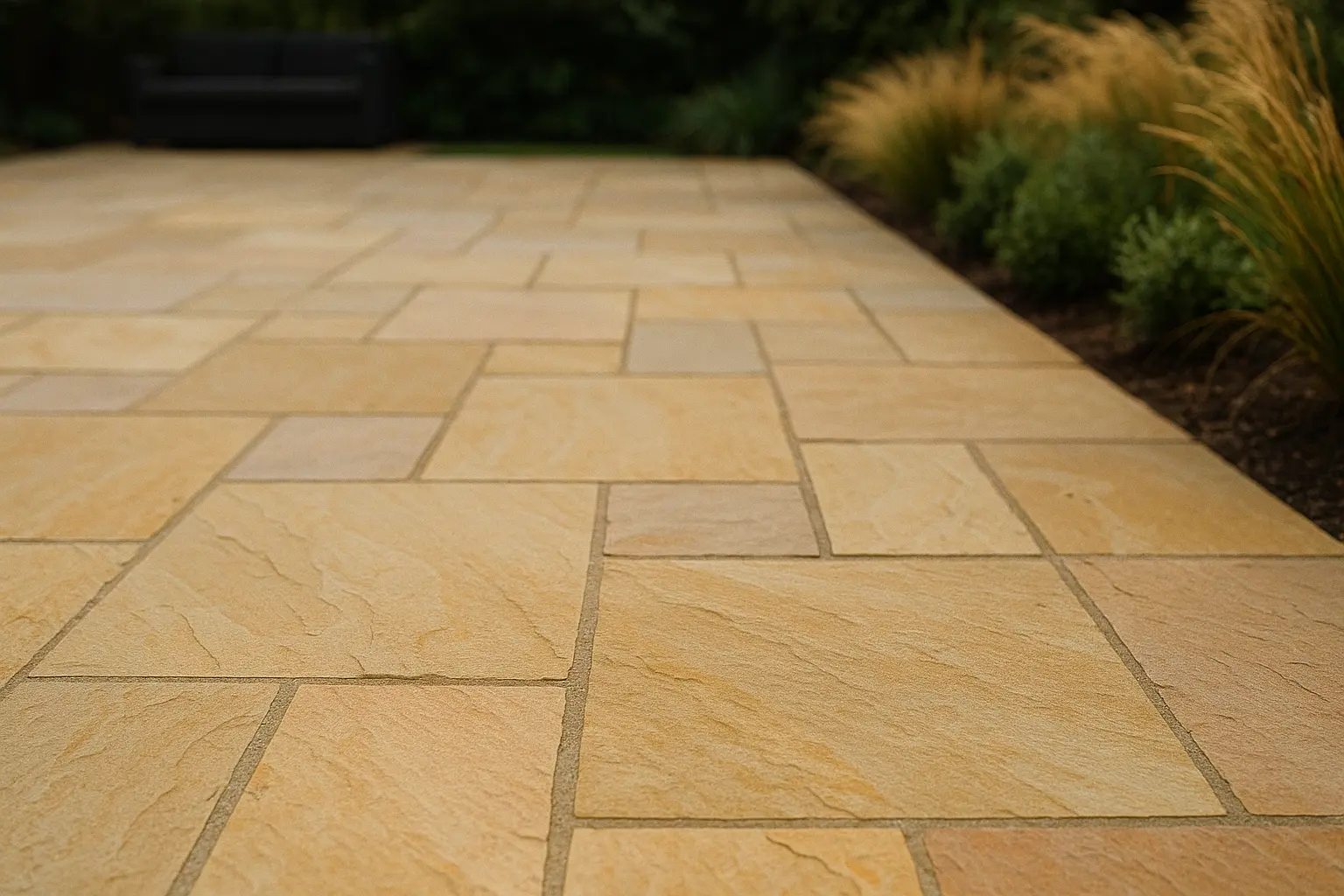
Why sandstone quality varies, what to look for in the stone itself, and how sourcing and test information can help with product selection.
Not automatically. On a sloping Haslemere garden, the important issues are the underlying construction, drainage, retaining structures, steps and finished levels. Either porcelain or sandstone can work well once those elements have been properly designed.
Yes, although shaded and damp areas need sensible drainage and maintenance. Sandstone is more porous than porcelain, so the particular stone, surface, surrounding planting and cleaning regime all need to be considered.
Porcelain commonly costs more, particularly once the additional installation requirements are included, but the difference depends on the products selected and the construction required for the garden.
There is no fixed rule. Natural sandstone can sit very comfortably with older brick, stone and established gardens, while porcelain can work extremely well with contemporary extensions and modern landscaping. The paving should be considered as part of the architecture and garden design rather than in isolation.
Outdoor porcelain normally does not require sealing in the way porous natural stone can. It still needs appropriate cleaning and good drainage.
It depends on the stone, finish and situation. Sealing can be useful in some applications, but it should not be treated as a substitute for proper drainage, falls and construction.
Explore our wider landscaping guides for Haslemere, Hindhead, Shottermill, Grayswood, Beacon Hill and surrounding Surrey Hills villages:
If you're considering a new patio, driveway or full garden transformation, we'd be happy to talk through your ideas and advise on the best way forward.
Call: 01428 654812 · 07500 877949
Email: richard@tlchaslemere.co.uk
WhatsApp: Send a WhatsApp message
Telegram: Message on Telegram